 Sadharo
Lying practice
Nail board for your back: how to lie on it, and who shouldn't
A sadhu board for back practice isn't the same board you stand on. It's two halves with a gap down the middle, so your spine rests between the nails, never on them. Here's how lying on nails differs from standing, which spacing to pick, how to lie down and get up safely, what the research on back pain actually shows, and who should skip it.
- The Sadharo team
- Updated September 27, 2026
- 10 min read
In short
- Yes, you can lie on nails, but only on a back board from a trusted shop: two halves, with your spine in the gap between them. No foot boards, no homemade gear.
- It's usually a little easier than standing: your weight spreads over your whole back. That's why back boards have wider spacing: 12 mm is the gentler one, 15 mm the classic.
- Go slowly: sit with your back to the board, lie down gradually, a bolster under your lower back and neck, ideally with a helper. Get up the same way. One minute is plenty the first time.
- It isn't a back treatment. The only trial we found tested an acupressure mat alongside exercise therapy. With back pain, a herniated disc or an injury, see a doctor first.
Can you lie on a bed of nails?
You can lie on a bed of nails if it's built for your back. Lying on nails is far older than the standing board: the bed of nails is the classic image of the sadhus, Indian ascetics, for some of whom it's a form of austerity (more in sadhu board origin). The home version is a back board: two halves you lie on, with a gap for your spine.
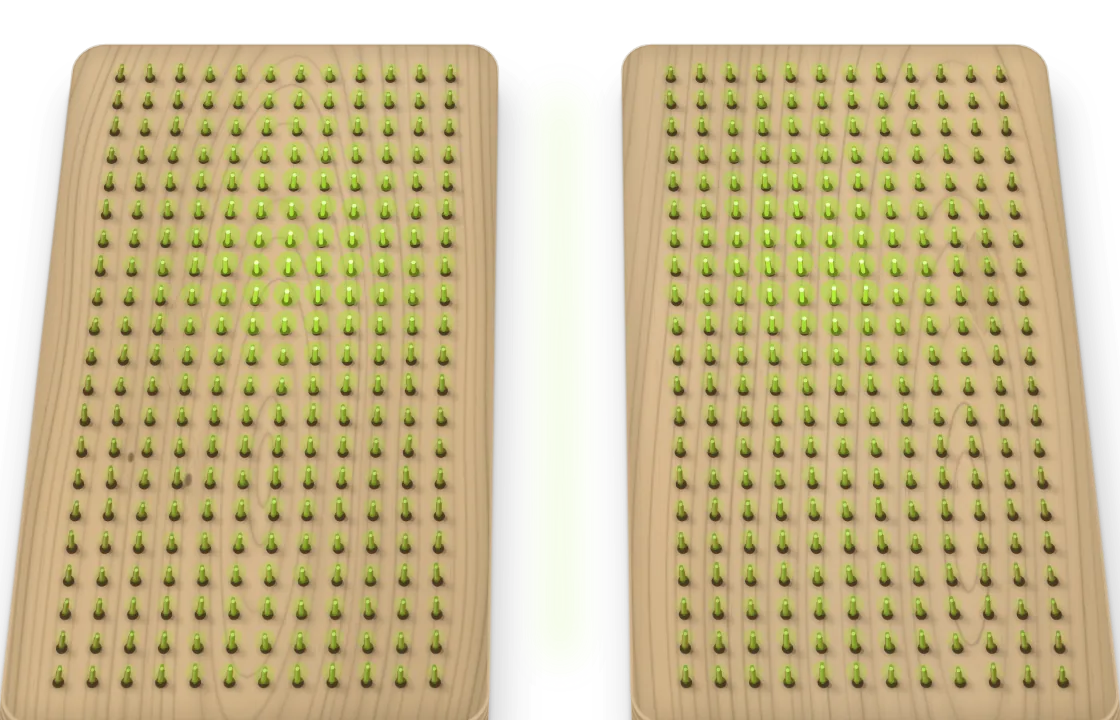
The gap is the whole point. The nails must never touch your spine: they press into your back on either side of it. Boards made for your feet aren't built for this, so don't lie on them, and don't improvise with a homemade board.
Sadhu board for back vs for feet: what's different
Lying down, your weight spreads over a far larger area than your two soles. Each nail carries less, so lying is usually a little easier than standing. That's also why back boards come with wider nail spacing than foot boards: at the same spacing, a back board would feel much softer.
| Back board spacing | How it feels | Who it suits |
|---|---|---|
| 12 mm | the gentler one | a first back board, or if you stand on 8 or 10 mm boards |
| 15 mm | the classic back-board spacing | people already used to strong sensations |
A simple rule of thumb: if your foot boards are 8 or 10 mm, start with a 12 mm back board; if you already stand on 12 or 15 mm, 15 mm will feel familiar. How spacing changes the load on each nail is explained in the sadhu board spacing guide.
How to lie on a nail board safely
A nail board to lay on asks for more care than one you stand on: you can't just step off. Board makers add these rules for lying practice.
- Pick a proper back board. Only a back board from a trusted shop, no homemade gear.
- Set up. Lay the board on a level surface. Have a bolster ready for your lower back and one for your neck. A helper nearby is even better.
- Sit, then lie down slowly. Sit with your back to the board and lower yourself gradually, leaning on your hands.
- Spine in the gap. Your spine goes between the halves. The nails stay on either side and never touch it.
- Let your weight down. Let your back sink so the weight spreads across its whole surface. Breathe slowly, with the exhale longer than the inhale.
- Get up the same way. Slowly, with your whole body, in reverse order. Your helper can give you a hand.
The first time, one minute is plenty. Add time gradually, only once your current time feels calm, just as you would standing. The basics of a first session on the nails are in how to use a sadhu board.
What lying on nails feels like
Lying on nails follows roughly the same arc as standing, just a little softer. It's a typical pattern, not a promise.
- First seconds. Sharpness: it's just new contact. Keep your spine in the gap and exhale longer than you inhale.
- 30 to 60 seconds. Resistance peaks. Keep breathing and don't tense up: it passes.
- 1 to 2 minutes. Let your back sink. Warmth often spreads across it; just notice it.
- Later. Lying down, the sharpness often fades sooner than when standing, and a second, calm stage sets in. You can close your eyes.
Red dots on your back afterwards are normal. They usually fade within a few hours, 8 hours at most. If they last longer, see a doctor. More on what's normal in does standing on nails hurt.
Does a sadhu board help back pain? What the research says
Whether a sadhu board helps back pain hasn't been tested directly: we couldn't find any controlled studies on back boards. The closest trial is on a softer relative, the acupressure mat. In it, 44 people with chronic low back pain did six months of therapeutic exercise, and half of them also lay on an acupressure mat for 60 minutes a day. Pain scores on a visual scale dropped significantly only in the mat group, while pain questionnaire, disability and quality-of-life scores improved in both groups (Frizziero et al., 2021).
That's one small study of plastic spikes plus supervised exercise therapy, not a metal back board on its own and not standing on nails. How the two tools compare is in sadhu board vs acupressure mat.
The honest take: many people find lying on nails relaxing, and some notice warmth spreading across their back. But a nail board doesn't treat back conditions, doesn't “straighten” your spine and won't fix a herniated disc or scoliosis. If your back hurts, you have a disc problem or you've had an injury or surgery, see a doctor before you lie on nails.
Who shouldn't lie on nails
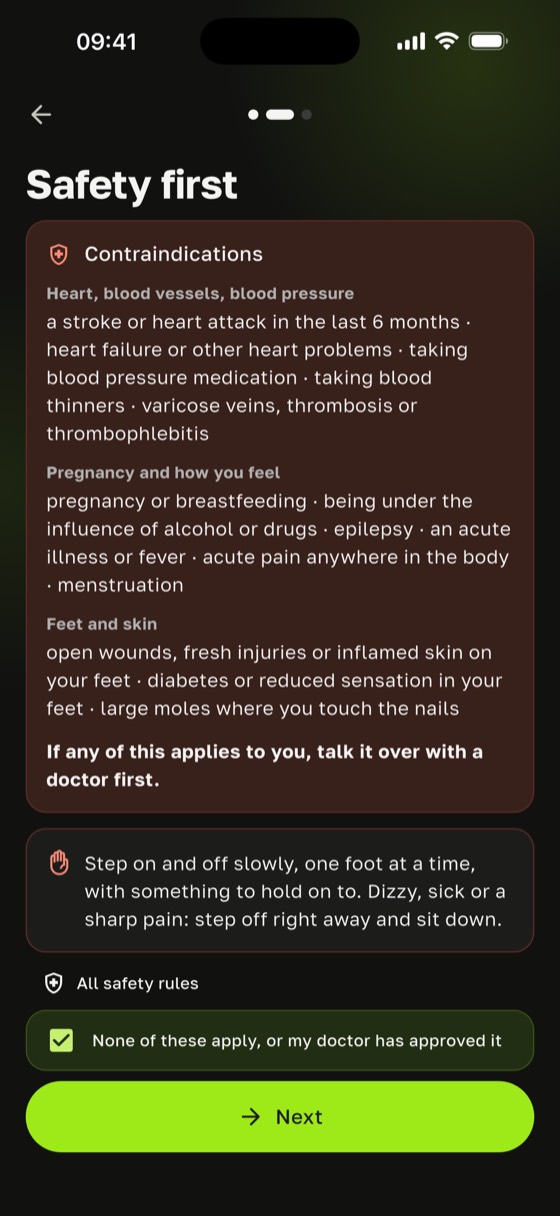
Everything that rules out standing on nails applies to lying too. Board makers list pregnancy or breastfeeding, your period, a stroke or heart attack in the last 6 months, heart problems, blood pressure medication, acute pain anywhere in the body and being under the influence. Varicose veins, diabetes, epilepsy, blood thinners and a fever are reasons to check with a doctor first. The full list, with the reasons behind it, is in sadhu board side effects.
For the back, board makers add:
- damaged or inflamed skin on your back;
- large moles on your back: take special care, and ask a doctor first.
If you need to stop
Don't jump up. Sit up slowly the way you lay down, stay seated for a moment, and only then stand. Stop right away, in that same slow way, if you feel very dizzy or sick, get a sharp unusual pain or numbness, feel weak as if you might faint, or suddenly feel much worse.
Lying practice in the Sadharo app
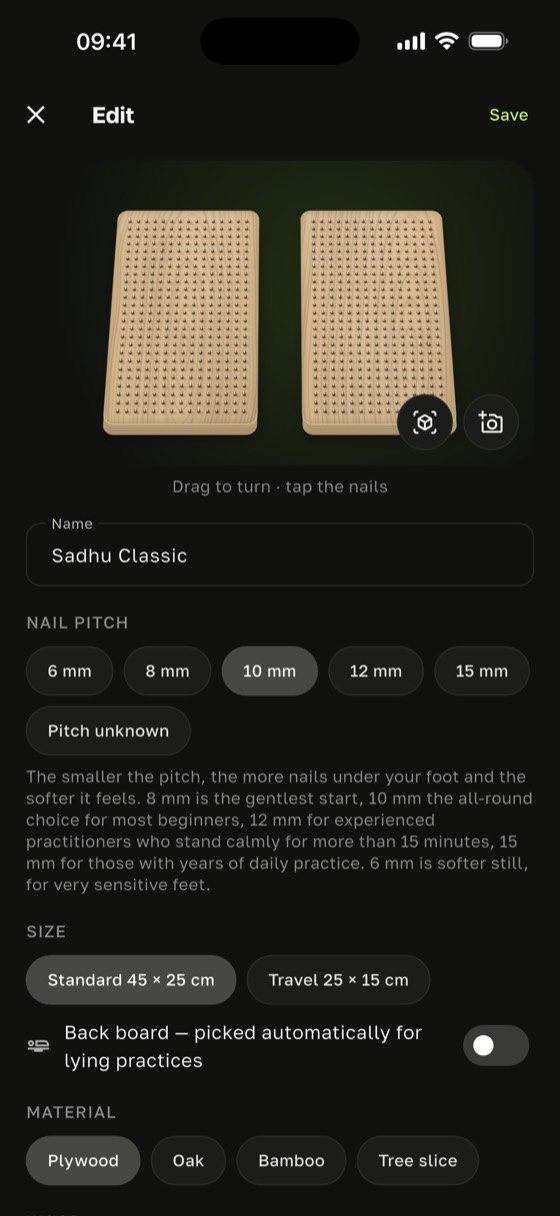
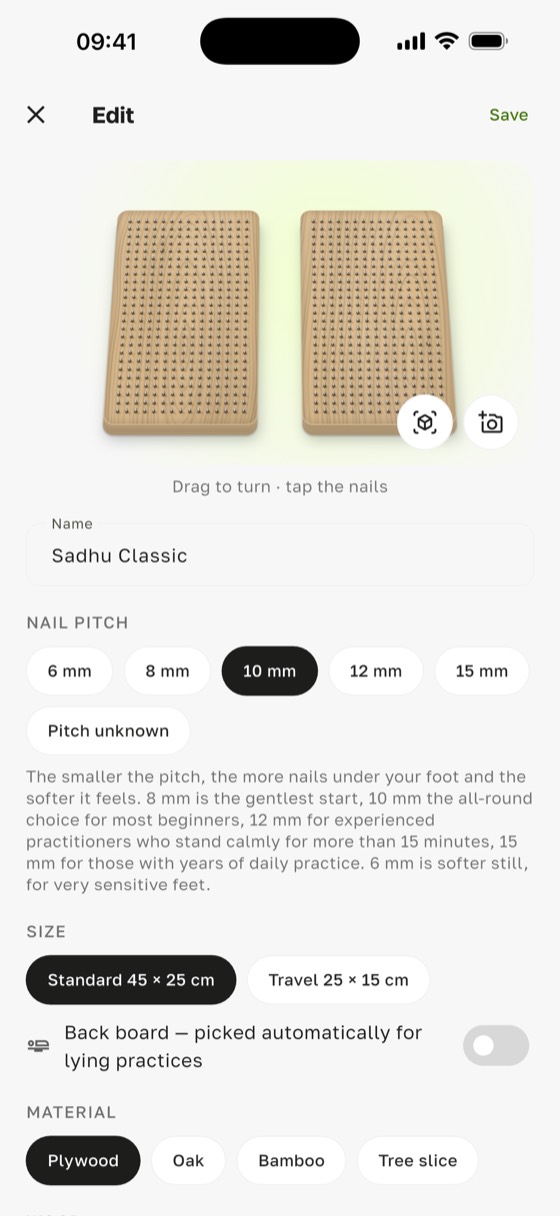
In Sadharo, mark your board in the board editor with the switch “A back board, for lying practice”. Then pick Lying down in the timer before you start. The first time, the app shows the lying rules once. During practice, the timer gives cues written for lying: spine in the gap, let your back sink, get up slowly. Your records for lying are kept separately from standing, so a minute on your back never competes with ten on your feet.
Questions about lying on a nail board
What does lying on a bed of nails do?
Much the same as standing: a strong sensation pulls your attention into your body, and many people come away calmer and warmer. It's usually a little gentler, because the weight spreads across your whole back. What it doesn't do is treat back conditions. The honest overview is in sadhu board benefits.
Is lying on nails easier than standing?
Usually, yes: the contact area is much larger, so each nail carries less. That's why back boards use wider spacing, 12 or 15 mm, to keep the sensation noticeable.
How long should you lie on a nail board?
One minute the first time. After that, add time gradually and only when your current time feels calm. There's no fixed target: stop earlier if anything feels wrong.
Can I lie on my foot boards?
No. Foot boards aren't made for lying on. A back board is laid out so your spine rests in the gap and the nails never touch it. For lying, use a proper back board from a trusted shop.
Is a sadhu board good for lower back pain?
There's no research on back boards. One trial found that lying on an acupressure mat alongside exercise therapy lowered chronic low back pain more than exercise alone. With back pain, see a doctor first: a nail board isn't a treatment.
Sources
- Frizziero A. et al. Efficacy of an Acupressure Mat in Association with Therapeutic Exercise in the Management of Chronic Low Back Pain: A Prospective Randomized Controlled Study. Applied Sciences, 2021, 11(11): 5211. doi:10.3390/app11115211
This article isn't medical advice. Sadharo isn't a medical device. Effects are described from practitioners' experience and published research, not as a promise of results.