 Sadharo
Benefits
Nail board benefits: what standing on nails really does for you
Sadhu board benefits are easy to oversell. Search for them and you'll find lists promising healthier organs, cleaner blood and a new life. Here's the honest version: what standing on nails actually does, what the research says, where the downsides are, and who should skip it.
- The Sadharo team
- Updated October 13, 2026
- 10 min read
In short
- The real benefit: a few minutes on a sadhu board help many people release tension and quiet racing thoughts.
- What research shows: in a study of acupressure mats, regular relaxation lowered perceived stress and improved sleep and concentration, with or without the spikes.
- What's missing: any evidence that standing on nails heals organs, “detoxes” you or fixes circulation.
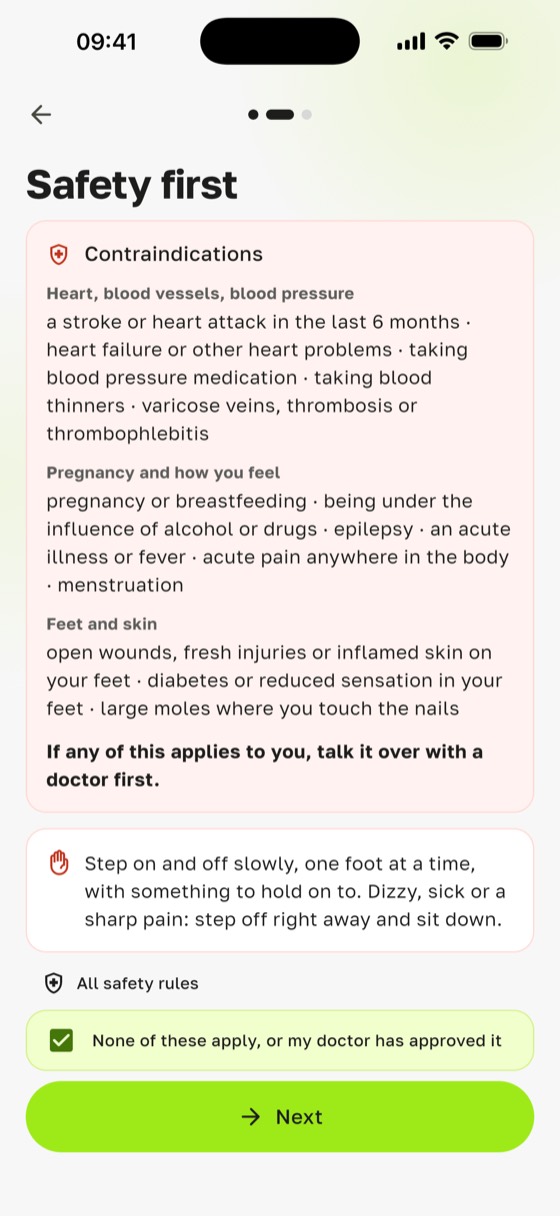
- Who should skip it: pregnancy, heart problems, blood pressure medication, wounds on the feet and a few other cases.
What is a sadhu board?
A sadhu board is a wooden board with even rows of nails that you stand on barefoot, usually for 1 to 20 minutes. It's named after the sadhus, Indian ascetics, some of whom lie on a bed of nails as part of their spiritual practice. Where the name comes from is in sadhu board origin.
The nails don't pierce the skin because your weight spreads over hundreds of points. With 10 mm nail spacing, a size EU 40 foot (about US men's 7 or women's 8.5) rests on roughly 170 nails. At 70 kg (154 lb), each nail carries about 200 g (7 oz). You can check the numbers for your own weight in the nail load calculator.
Why stand on nails? What a sadhu board is used for
Why stand on nails at all? Today most people use a sadhu board not for asceticism but to pause for a few minutes. Once you step onto the nails, your attention goes straight to your body and breath. You don't need meditation experience or the ability to “clear your mind”: the sensation simply won't let you drift.
Some people use it to decompress after work, some to wake up in the morning, some to practice staying calm through discomfort. How that plays out with everyday stress is covered in sadhu board for anxiety.
Sadhu board benefits people report
What does standing on nails do for you? These are the effects regular practitioners describe most often. They come from experience, not clinical trials, but they're easy to check for yourself.
A quieter head
The sensation under your feet takes all of your attention, and the stream of thoughts dies down on its own. For many people that's the whole point: a couple of minutes, and the noise fades.
Breathing instead of flinching
In the first seconds everything in you says “get off!” If you stay and breathe out slowly, the wave passes. Many people find the skill carries over off the board: noticing stress without reacting to it straight away.
Warm, awake feet
The nail board benefit for your feet that people notice first is warmth: after a practice many feel warmth and tingling in their soles and a lift in energy. Some stand in the morning to wake up, others in the evening to switch off from work. What a nail board does for your feet in particular, and what's known about plantar fasciitis, flat feet and swelling, is in sadhu board for feet.
A ritual that's easy to keep
A few minutes is small enough to fit into any day. And a regular pause helps in its own right, as the research below shows.
Do nail boards work? What the research says
Do nail boards work in a way research can measure? We couldn't find any published controlled studies on standing on a sadhu board itself. The closest relative is the spiked acupressure mat, and two studies on mats give an honest sense of scale.
- Stress, sleep and focus. In a 2023 study, healthy young students new to the practice did three weeks of relaxation training, some on an acupressure mat and some without one. In both groups perceived stress went down, while sleep quality and concentration endurance went up, with no significant difference between the groups. Blood pressure, heart rate, pain threshold and pain tolerance didn't change. In other words, the regular relaxation helped, and the mat added nothing measurable on top (Kisker & Schöne, 2023).
- Back pain. In a randomized trial, 44 people with chronic low back pain did six months of therapeutic exercise, and half of them also lay on an acupressure mat for 60 minutes a day. Pain scores dropped significantly only in the mat group. But that's lying on a mat alongside exercise therapy, not standing on nails (Frizziero et al., 2021). What lying on nails involves is covered in sadhu board for back.
The honest conclusion: a few calm minutes on a sadhu board can help you feel less stressed, the way any regular relaxation break can. There's no evidence that it heals your kidneys, thyroid or spine through points on your feet. If a board is sold as a cure, that's marketing, not science.
How to check the effect on yourself
Since the main effect is subjective, the best way to know whether a sadhu board works for you is to measure it. Rate your tension and energy from 1 to 10 before a practice and again after. In two weeks you'll have your own numbers instead of someone else's promises. What usually changes over weeks of daily practice is covered in sadhu board before and after.
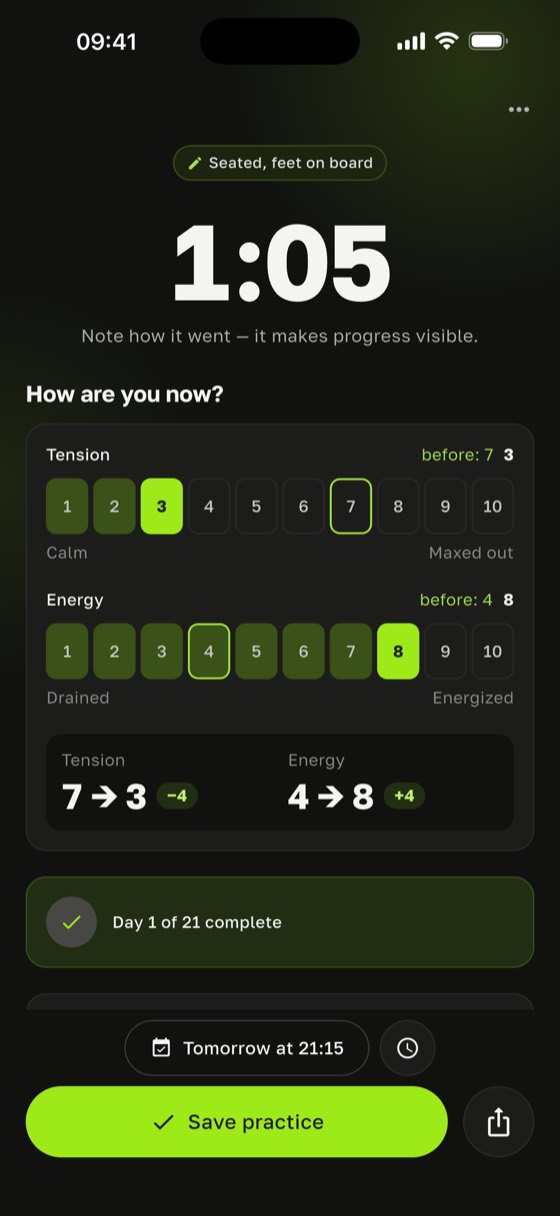
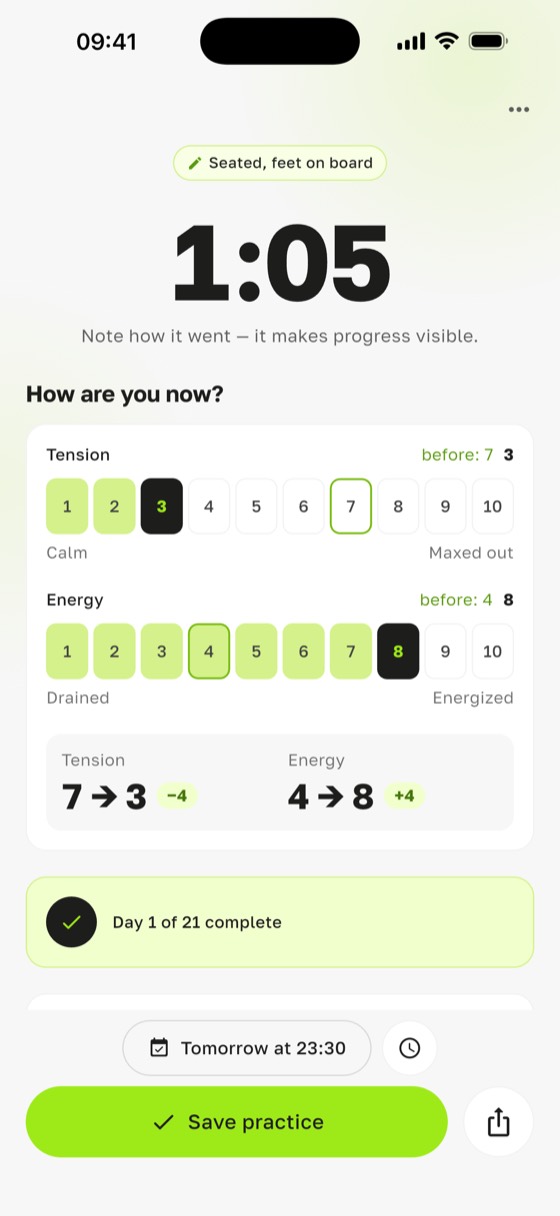
The Sadharo sadhu board app has this check-in built in: five seconds before, five after, and every practice shows how your scores changed.
Benefits and side effects: what can go wrong
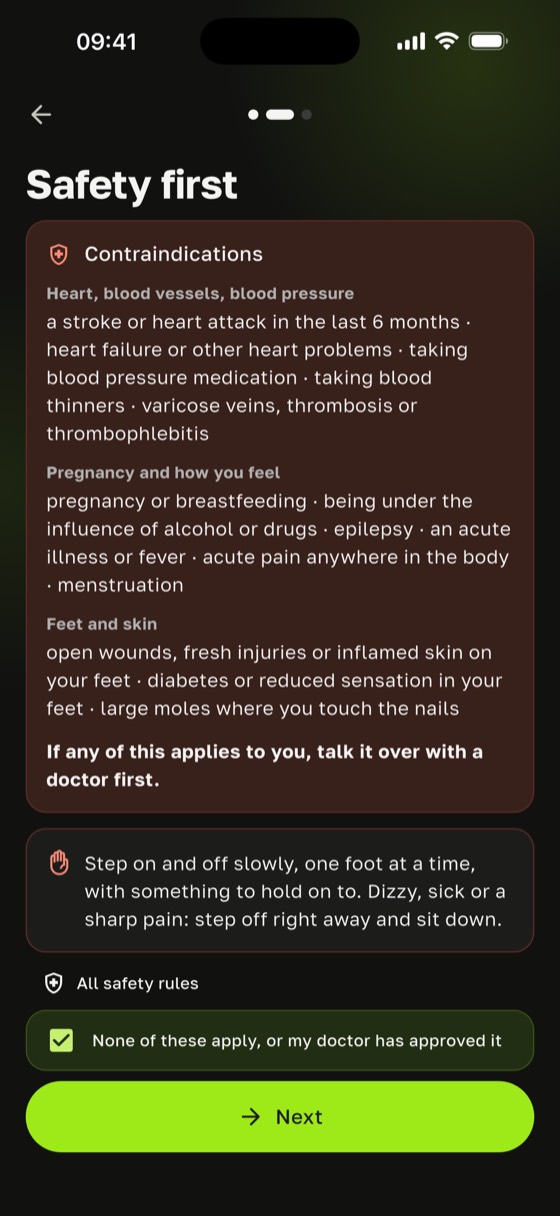
Like any practice, a sadhu board has side effects as well as benefits. For most healthy adults, standing on nails isn't harmful in itself: the risks come from how you get on the board and how long you push through.
- Dizziness and fainting. Standing still, a breath frozen by tension and a sharp reaction to pain can make you lightheaded. A fall onto the nails or furniture is riskier than the practice itself.
- Small wounds. Rare on a good board with a slow step. The risk grows if you jump on, or if the nails are uneven, rusty or burred.
- Reduced feeling in the feet. With diabetes or neuropathy you may not notice damaged skin in time.
- Pushing through. A record doesn't make practice more useful. Sharp pain, numbness or nausea mean step off, not “detox”.
Who should skip the practice and what to watch for is covered in full in sadhu board side effects.
How to get the benefits safely
- Start seated. Spend your first minute on a chair with your feet on the board. The load is several times lower.
- Pick a gentler board. 10 mm spacing is the all-round choice for most beginners; 8 mm is the gentlest start. More in the sadhu board spacing guide.
- Keep support nearby. A wall, a chair or a person. Step on and off slowly, one foot at a time, never jump.
- Breathe slowly. Exhale longer than you inhale, keep your knees soft, and don't let tension freeze your breath.
- Add time only when it's comfortable. A minute every day beats ten minutes of gritted teeth once a week.
Step-by-step instructions are in how to use a sadhu board.
Questions about sadhu board benefits
Is it good to stand on nails every day?
Yes, if you have no contraindications and aren't forcing it. Many people practice daily, and consistency matters more than duration. See how long to stand on a sadhu board for a week-by-week plan.
Are sadhu board benefits different for women?
There's no separate data: the effects people describe are the same for everyone. Board makers do advise skipping practice during pregnancy, breastfeeding and your period.
Why does standing on nails hurt at first?
In the first seconds your feet meet hundreds of pressure points and your body reads it as a threat. The sharpness usually eases within minutes; for many it fades between minutes 5 and 10. More in does standing on nails hurt.
Is a sadhu board worth it?
If you want a few calm minutes a day and aren't expecting a cure, many people find it is. It won't heal anything, but as a short daily pause it's hard to do halfway: the nails hold your attention for you. Try two weeks of short daily practice and compare how you feel before and after.
Sadhu board vs acupressure mat: what's the difference?
An acupressure mat is a soft pad with plastic spikes that you usually lie on. A sadhu board has metal nails on a rigid base, you stand on it, and the sensation is much stronger. The full comparison is in sadhu board vs acupressure mat.
Sources
- Kisker J., Schöne B. Regular use of acupressure mats reduces perceived stress at subjective but not psychophysiological levels: Insights from a three-week relaxation training. Applied Psychology: Health and Well-Being, 2023. doi:10.1111/aphw.12490
- Frizziero A. et al. Efficacy of an Acupressure Mat in Association with Therapeutic Exercise in the Management of Chronic Low Back Pain: A Prospective Randomized Controlled Study. Applied Sciences, 2021, 11(11): 5211. doi:10.3390/app11115211
This article isn't medical advice. Sadharo isn't a medical device. Effects are described from practitioners' experience and published research, not as a promise of results.