 Sadharo
For your feet
Nail board for feet: the real benefits, and who should skip it
A sadhu board for feet is the classic version of the practice: a pair of boards, one under each foot, that you stand on barefoot for a few minutes. Here's what it actually does for your feet and what it doesn't, what's known about plantar fasciitis, flat feet and swelling, how to place your feet, and which nail spacing to choose.
- The Sadharo team
- Updated October 13, 2026
- 13 min read
In short
- What it does: strong, even pressure across your whole sole. Afterwards many people notice warmth, tingling and lighter legs. That's practitioners' experience, not clinical data.
- What it doesn't: there's no research showing that standing on nails treats plantar fasciitis, flat feet, heel spurs or swelling. With a diagnosis, see a doctor or podiatrist first.
- How to stand: boards hip-width apart, weight even on both feet and on three points of each: the heel, the base of the big toe and the base of the little toe. Soft knees, slow weight shifts.
- Which spacing: 8 or 10 mm to start, 6 mm for very sensitive feet.
What is a sadhu foot board?
A sadhu foot board is a wooden board with even rows of nails, and you use two of them, one under each foot. You lay them side by side on a level floor, hip-width apart, and step on barefoot. A minute is plenty the first time; experienced practitioners stand for 10 to 20 minutes, building up gradually.
On a well-made board the nails don't pierce your soles, because your weight spreads over hundreds of points. With 10 mm spacing, a size EU 40 foot (about US men's 7 or women's 8.5) rests on roughly 170 nails, so at 70 kg (154 lb) each nail carries about 200 g (7 oz). You feel strong pressure, but the skin stays intact as long as you step on slowly, never jump, and skip practice on damaged skin. You can check the numbers for your own weight and shoe size in the nail load calculator.
Nail board for feet benefits: what people notice
The benefits of a nail board for feet below come from what practitioners describe, not from clinical trials: no study has looked at the feet specifically. They're easy to check for yourself, though.
Your attention drops into your feet
The first one is simple: hundreds of nails under your soles take all of your attention. Racing thoughts quiet down, and feet you barely notice in shoes suddenly feel whole: heels, balls, toes. For a few minutes your head rests while your body is in focus.
Warmth and tingling
The benefit people mention most is warmth. A few minutes in, and afterwards, the soles warm up, tingle, and the legs feel lighter. That's a normal response. It's often put down to “better circulation”, but we haven't found any measurements of that for standing on nails.
Your feet get used to it
With regular practice the sharpness fades: your feet adapt and the calm minutes on the board get longer. The first seconds are usually the sharpest; for many people the intensity drops into the background somewhere between minutes 5 and 10.
What it doesn't do
Points on the soles are often linked to organs: “stand on nails and heal your kidneys or thyroid”. There's no evidence for that. The honest overview of what the practice does in general is in sadhu board benefits.
Nail board for feet: side effects to know
A nail board for feet rarely causes harm when you practice sensibly. When it does, it's usually one of four things:
- A small wound from a poor board or a jump. Uneven, rusty or burred nails and stepping on hard raise the risk. Step on slowly, one foot at a time.
- A wound you don't notice. With diabetes or reduced feeling in your feet you might not notice damaged skin, and it can heal slowly. With diabetes, check with your doctor first and look at your feet after every session.
- Practicing on damaged skin. Open wounds, fresh injuries or inflamed skin on your feet are on the board makers' list of contraindications. Deep cracks in your heels count as damaged skin too: wait until they heal. Large moles where your feet touch the nails are worth showing a doctor first.
- Dizziness and falls. Standing still, a breath frozen by tension and a sharp reaction to pain can make you lightheaded. That's why a wall, a chair or a helper should be close by the first few times.
Red dots and dents on your soles afterwards are normal and usually fade within a few hours. Step off right away if you feel very dizzy or sick, or get an unusual sharp pain or numbness: slowly, holding on, then sit down. The full list of who should skip the practice and why is in sadhu board side effects.
Sadhu board for plantar fasciitis and flat feet: what's known
A sadhu board for plantar fasciitis hasn't been tested: we couldn't find any studies of standing on nails for plantar fasciitis, heel spurs or flat feet. Claims that a nail board will “fix” your arches or “break up” a heel spur are marketing, not data.
What we can say honestly:
- Plantar fasciitis and heel spurs. If your heel hurts right now, that's acute pain, and acute pain is on the makers' list of contraindications. Hold off, and see a doctor or podiatrist first. Pressing nails into a sore spot to “work out” the pain isn't a good idea.
- Flat feet. There's no evidence that a board changes the shape of your arch. With flat arches the middle of the foot rests on the nails almost entirely; with high arches more weight goes to the heel and the ball of the foot, so it feels different for everyone. Flat feet aren't on the makers' list of contraindications, but treatment is for a podiatrist to decide.
- If your doctor is fine with it. Start seated on a chair, so less weight rests on your feet, and pick a soft spacing, 8 or 6 mm. Sharpness in the first seconds is normal; a sharp pain in one spot that doesn't ease is a signal to step off.
Swelling and heavy legs: can a nail board help?
Whether standing on nails helps with swelling hasn't been measured either. Many people say their legs feel lighter and warmer after practice, especially in the evening after a day on their feet or at a desk. That's a sensation, not a proven effect, and a nail board isn't a treatment for swelling.
What matters more: swollen feet and ankles can be a sign of heart, vein or kidney problems, so if your legs swell regularly, find out why with a doctor first. Heart failure is on the makers' list of contraindications. Varicose veins, thrombosis or thrombophlebitis are reasons to check with a doctor first: standing still for a long time with pressure on your feet is something to clear with them.
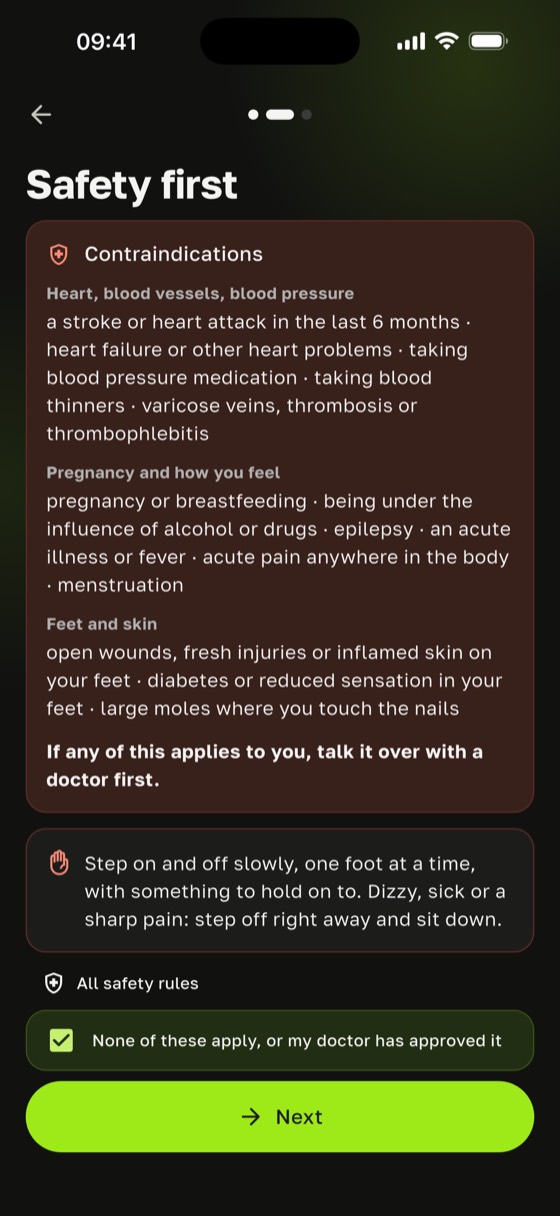
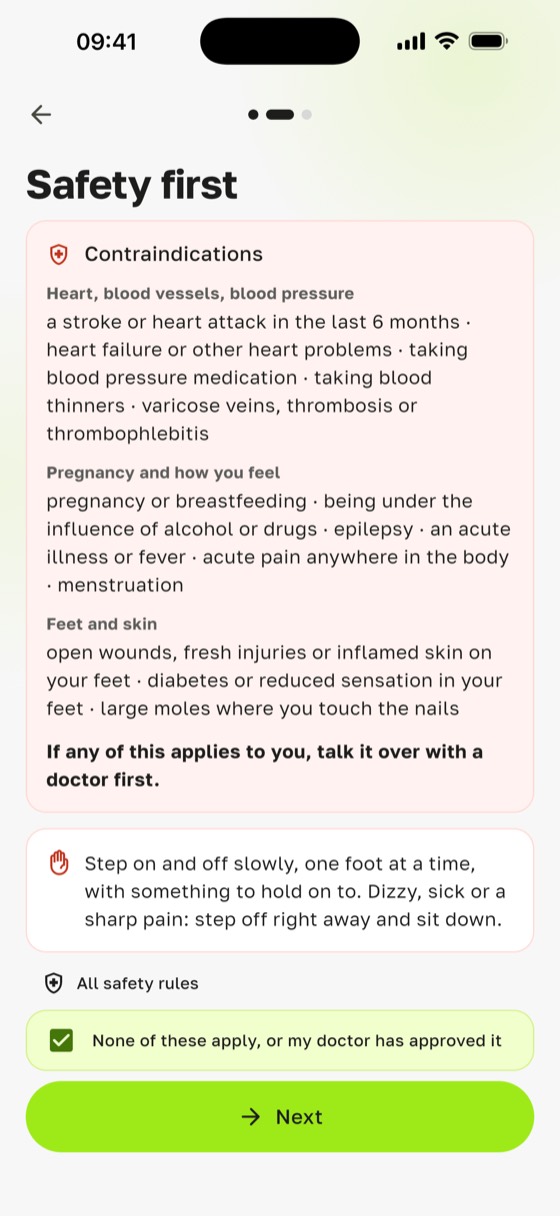
If your doctor says yes, keep sessions short and start seated. Every now and then, gently shift your weight from your heels toward your toes and from foot to foot, as described below.
How to stand on a sadhu board: heels, toes, three points
Standing on a nail board for feet is easiest in this order:
- Set up. Both boards side by side on a level floor, hip-width apart. Feet clean and dry, no cream. A wall or chair next to you, and a soft mat beside the boards to step onto afterwards.
- Step on one foot at a time. Never jump. Put one foot on its board, slowly shift some weight onto it, then bring the other foot onto the second board.
- Spread your weight. Evenly on both feet, heel and toe. On each foot, three points carry you: the heel, the base of the big toe and the base of the little toe.
- Keep your knees soft. Don't lock them, and don't hang back on your heels.
- Breathe. Slowly, with the exhale longer than the inhale. Don't let tension freeze your breath.
- Step off just as slowly. Shift your weight onto one leg, lift the other foot onto the mat, then follow with the first. Stand or sit for a minute: warmth and tingling in your feet are normal.
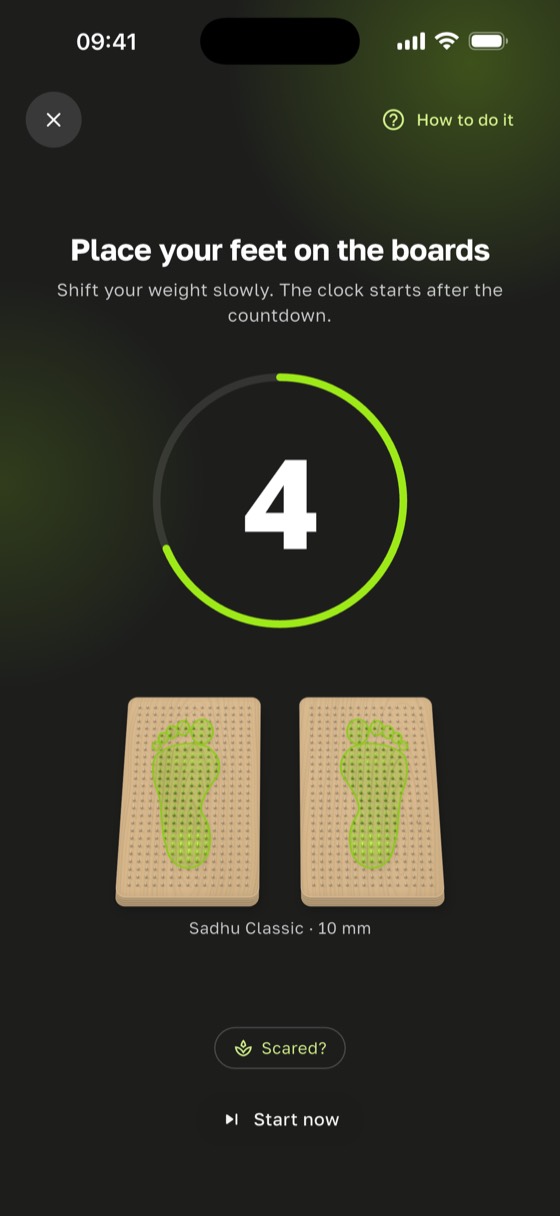
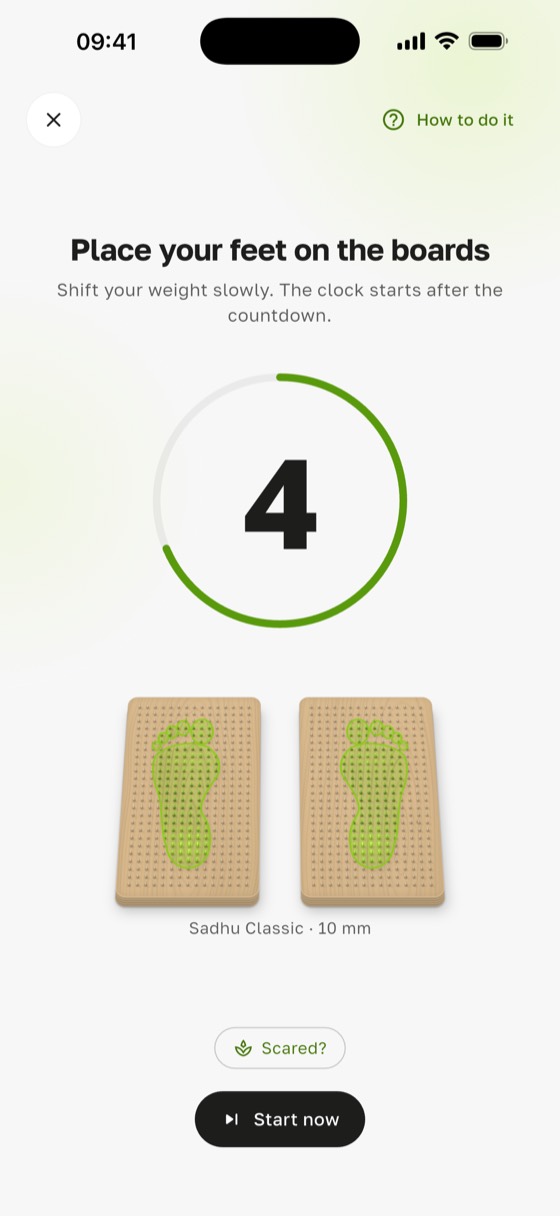
Once standing still feels calm, you can play with your weight the way Sadharo's “Shifting weight” lesson does: very slowly move your weight onto your heels, then back toward your toes, then gently sway from one foot to the other. It shows you which parts of your feet respond most. If it gets too intense, come back to the center and take a couple of calm breaths out.
Your first sessions, from a minute on a chair to a calm standing practice, are covered step by step in how to use a sadhu board.
Best nail board for feet: which spacing
The best nail board for feet is the one whose spacing matches your experience. Spacing is the distance between neighboring nails: the smaller it is, the more nails under your foot and the softer it feels. For a size EU 40 foot at 70 kg (154 lb):
| Nail spacing | Nails under one foot | Load per nail | Best for |
|---|---|---|---|
| 6 mm | about 480 | about 70 g (2.5 oz) | very sensitive feet |
| 8 mm | about 270 | about 130 g (4.5 oz) | the gentlest start |
| 10 mm | about 170 | about 200 g (7 oz) | most beginners |
| 12 mm | about 120 | about 290 g (10 oz) | 15+ calm minutes on 10 mm |
| 15 mm | about 80 | about 450 g (1 lb) | years of daily practice |
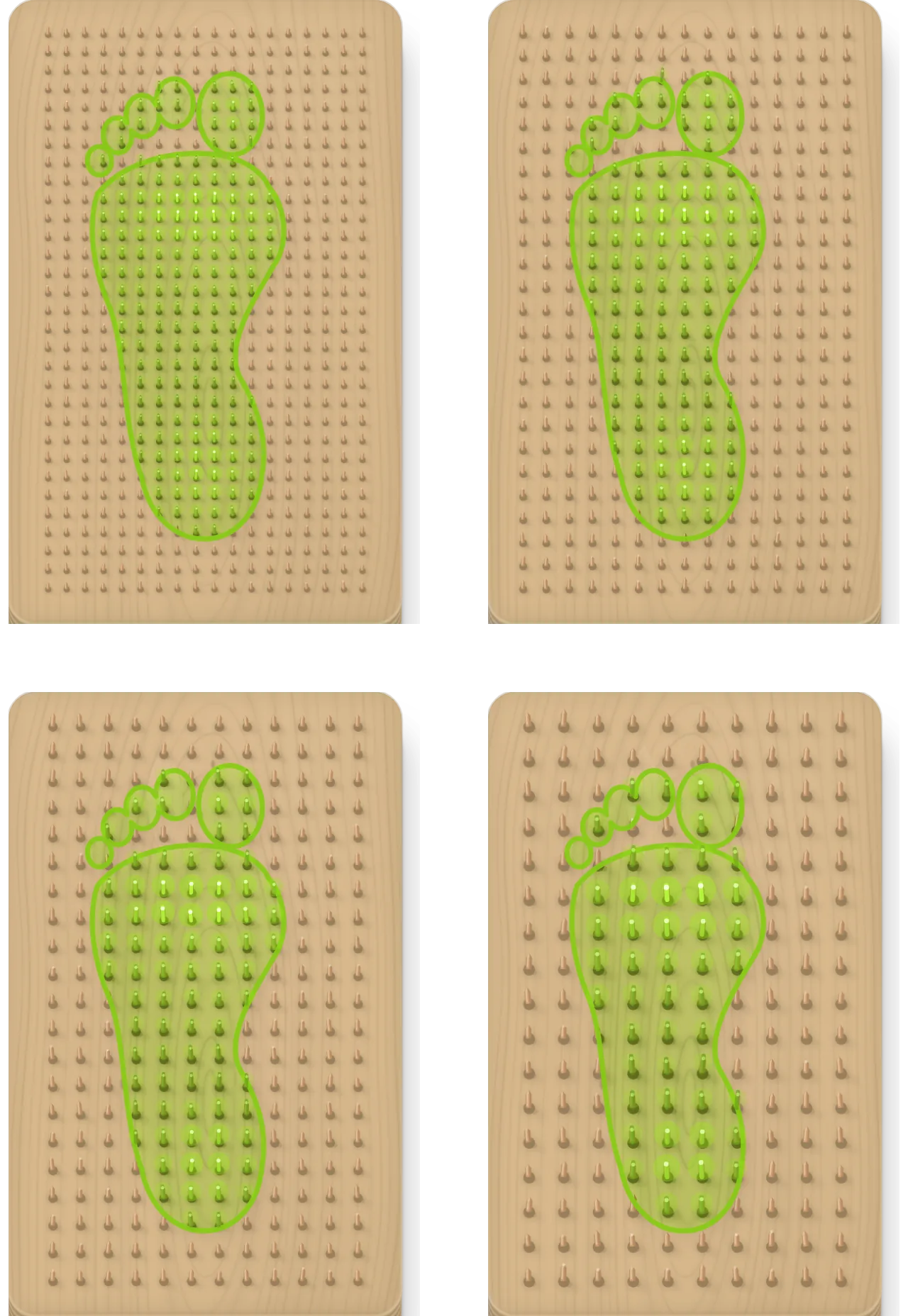
For your feet, three things matter:
- Sensitivity. If your soles are very sensitive, start on 8 or even 6 mm. Move to a sharper spacing once you stand calmly on yours for 15 minutes or more.
- Weight. The heavier you are, the more each nail carries: at 100 kg (220 lb) on 10 mm, about 290 g (10 oz) per nail, the same as a 70 kg (154 lb) person on 12 mm. If you're heavier, go softer.
- Socks. Thin socks soften the sensation and are a fine way to meet the board. In Sadharo, a session in socks counts toward your total time, but not toward your records or the nudge to move up to a sharper spacing.
In Sadharo you set the spacing in the board editor, and program goals adjust to it: a little longer on a soft board, shorter on a sharp one. More on spacing, nail metals and bases in the sadhu board spacing guide.
Your feet in the Sadharo app
The sadhu board app Sadharo tracks more than time. It helps you notice what happens in your feet:
- “Where did you feel it?” After a session you can mark on both feet where the nails pressed most: toes, balls of the feet, arches, outer edges, heels. Each tap on a zone makes it stronger: “A little”, “Clearly”, “Strongly”.
- “Sensation map”. Your marks build into a 30-day heatmap in Progress, along with the zones that changed most since your first maps, such as “Heels: was 3 → now 1”. It's an easy way to see your feet getting used to the nails.
- Days for your feet in the programs. First 21 Days has a “Warmth” day: after the sharp phase comes warmth, and the cue is to let it rise up through your legs. The 40-day program has “Breathing through the feet” and “Three points of the foot”.
Questions about sadhu boards for feet
Is a sadhu board good for your feet?
For most healthy people a sadhu board for feet is a safe practice that many find warming and calming. It isn't a treatment for foot conditions, though: there's no research on that. With pain, a diagnosis or reduced feeling in your feet, see a doctor first.
Can a sadhu board help plantar fasciitis?
There's no evidence that it does. If your heel hurts now, that's acute pain, which board makers list as a reason to skip practice. See a doctor or podiatrist first, and only return to the board, seated and on soft spacing, once they're fine with it.
Is a nail board a foot massager?
People often call it that, but it's more a practice than a massage. You don't knead your feet on a board; you stand still, and the point is strong, even pressure and how you breathe through it. It's much sharper than a massage mat, which is why people start with a minute, ideally seated.
Can I stand on a nail board in the morning?
Yes. Many people stand in the morning to wake up and in the evening to switch off after work. Just not on a full stomach: wait a couple of hours after a meal. How long to stand, week by week, is in how long to stand on a sadhu board.
Can I use a sadhu board with socks on?
Yes. Thin socks are a good way to meet the board for the first time. Once you feel calm, switch to bare feet: that's where the full sensation is.
This article isn't medical advice. Sadharo isn't a medical device. Effects are described from practitioners' experience and published research, not as a promise of results.