 Sadharo
Daily practice
The sadhu board experience: what daily practice changes, week by week
Sadhu board before and after: what actually changes when you stand on nails day after day? For most people the sensation softens, the calm minutes on the board grow longer, and the practice turns into a habit that's easy to keep. Below is the typical sadhu board experience week by week, how the program levels work, and how to read your own before-and-after scores instead of someone else's promises.
- The Sadharo team
- Updated October 13, 2026
- 13 min read
In short
- Week 1: getting acquainted. Two days seated for a minute, then 1.5–2.5 minutes standing with support.
- Week 3: 5–10 minutes standing. For many people the sharpness fades somewhere between minutes 5 and 10.
- Week 6 and beyond: time grows slowly, up to 15 minutes by day 40. Practice now rests on breath and attention rather than endurance.
- What won't happen: a guaranteed cure. Your own before-and-after scores show what changes for you.
Week 1: seated, then your first minutes standing
The first week is about getting acquainted, not toughing it out. In Sadharo's First 21 Days program, days 1 and 2 are spent seated on a chair, one minute each. From day 3 you stand, with support nearby, for one and a half to two and a half minutes.
This is when the sensation is at its brightest: sharp first seconds, then the hardest part, when everything in you says “get off”. Soft knees and an exhale longer than the inhale help. Above all, don't freeze up and hold your breath. By day 7 many people find that stepping on is no longer frightening, even if it still feels sharp. A step-by-step guide to this stage is in how to use a sadhu board.
Week 3: five to ten minutes
With daily practice, by week three you're standing for 5–10 minutes. This is when you first reach the point many people practice for: the sharpness often fades into the background somewhere between minutes 5 and 10, and you may feel warmth in your feet.
Some people notice by now that they switch off from work more easily or start the morning calmer. Others notice nothing special, and that's fine too: after three weeks you have something to compare. The day-by-day times are in how long to stand on a sadhu board.
Week 6: halfway through the classic cycle
If you go straight from First 21 Days into the 40-day program, week six lands in the middle of the cycle. You're at about 8–9 minutes, and the week's theme is observing pain: noticing that the sharpness comes in waves, and separating the sensation (“it burns”) from the story (“I can't take this”).
Many practitioners say this is roughly where the board stops being an ordeal and becomes training in staying calm: the discomfort is there, the panic isn't. The week ends with a gentle seated day and a question: what has changed in these three weeks? Write the answer down; it's worth rereading a month later.
Sadhu board before and after: how to see your own results
A sadhu board before-and-after isn't a photo of your feet. It's how you feel going in and coming out. What practitioners describe most is a skill: staying calm when something is unpleasant. We couldn't find controlled studies on standing on nails itself; the closest relative is the spiked acupressure mat:
- Three weeks of relaxation. Healthy young students new to the practice did three weeks of relaxation training, some on an acupressure mat and some without one. In both groups perceived stress went down, while sleep quality and concentration endurance went up, with no significant difference between the groups. Blood pressure, heart rate, pain threshold and pain tolerance didn't change (Kisker & Schöne, 2023).
- Six months with a mat. In a randomized trial, 44 people with chronic low back pain did six months of therapeutic exercise, and half of them also lay on an acupressure mat for 60 minutes a day. Pain scores dropped significantly only in the mat group. But that's lying on a mat alongside exercise therapy, not standing on nails (Frizziero et al., 2021).
Much of what regular practice gives you, then, seems to come from the pause itself. There's no evidence that standing on nails every day heals illness or changes how your organs work.
How to track it yourself
Since the main effect is subjective, measure it. Rate your tension and energy from 1 to 10 before a practice and again after. In two or three weeks you'll have your own numbers to go on.
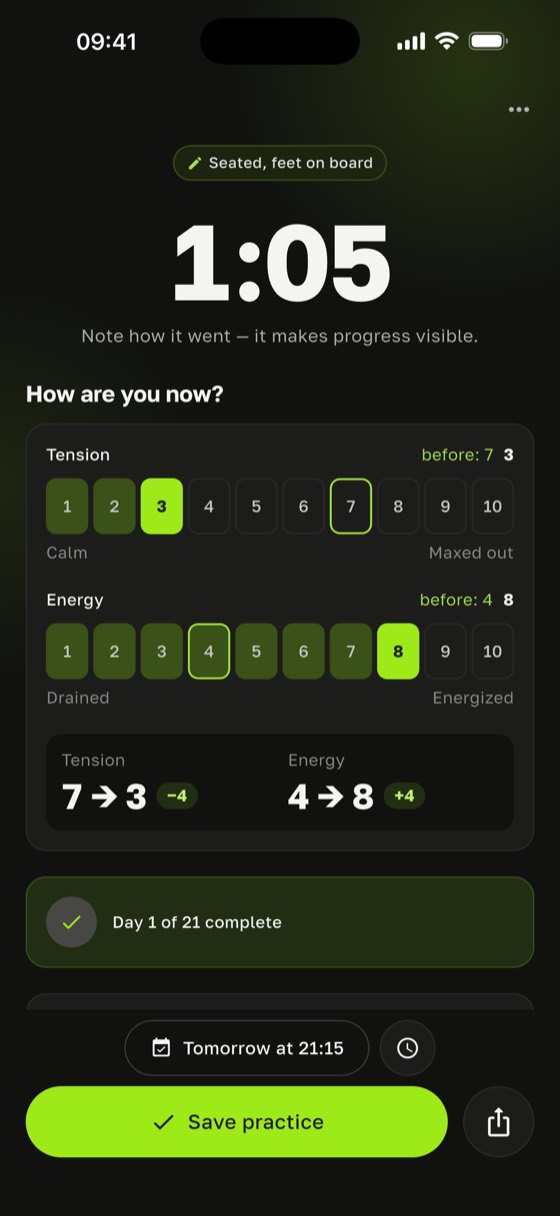
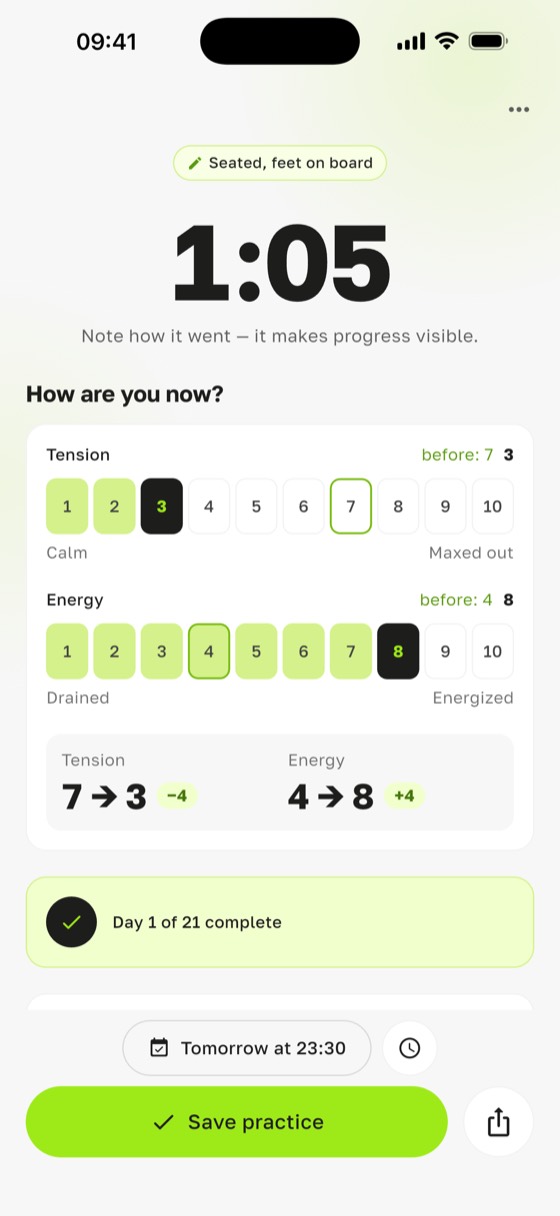
The Sadharo sadhu board app has this check-in built in: five seconds before, five after, and every practice shows how your scores changed. You can also note how hard it was, from “very hard” to “very easy”, and after a couple of weeks compare your first practices with your latest.
Daily health benefits of standing on nails, and their limits
The daily health benefits of standing on nails come mostly from regularity. A few minutes fit into any day, and, as the study above suggests, a regular pause on its own can help you feel less stressed. Practitioners also describe a quieter head, warm feet and an easier switch from work to home.
Daily practice has limits, though. Time doesn't grow forever: even the program for experienced practitioners tops out at 20 minutes, and longer isn't better. Daily doesn't mean forced. And a board isn't treatment: if something worries you, see a doctor rather than adding minutes on the nails. What the practice can and can't do is covered in sadhu board benefits.
Sadhu board levels: 21, 40 and 80 days
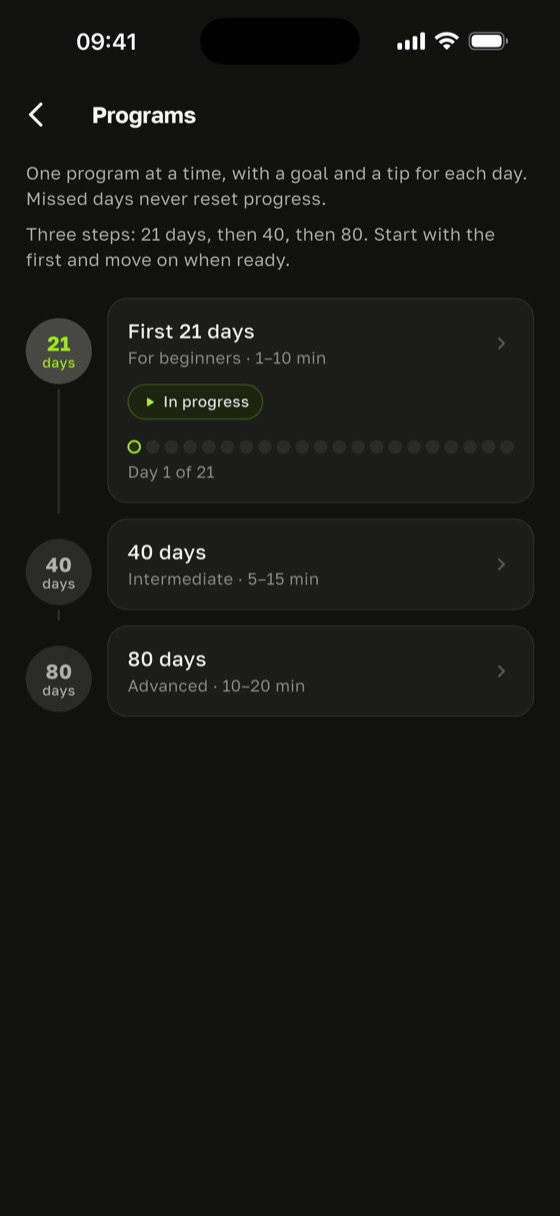
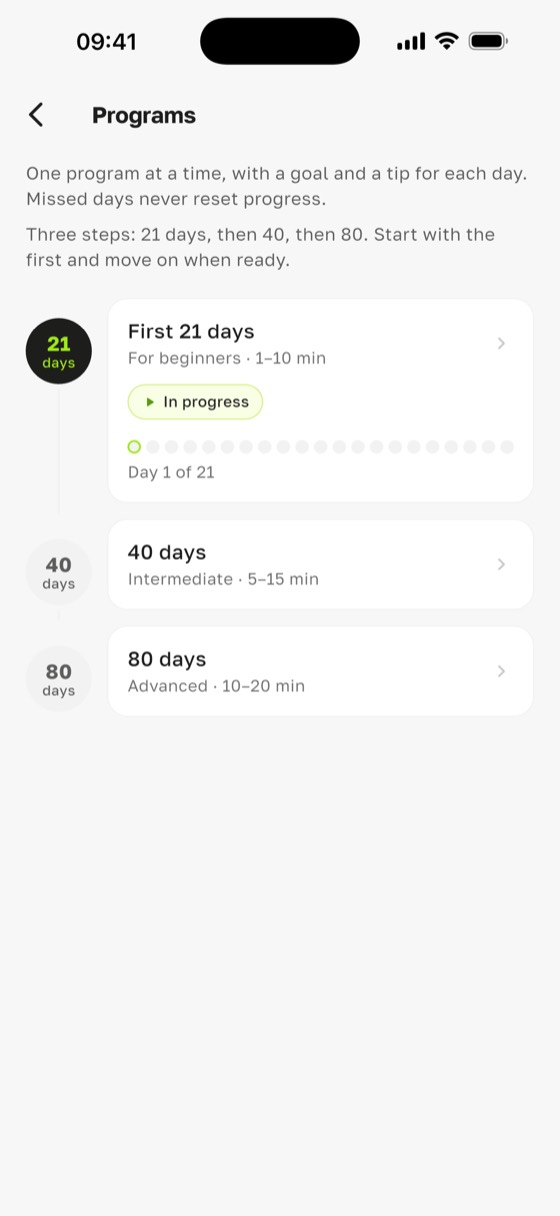
Sadhu board levels come in two kinds: the board and the way you practice on it. In shops, “levels” usually means nail spacing: 8 mm is the gentlest start, 10 mm the all-round choice, 12 and 15 mm for experienced practitioners. Choosing your spacing is covered in the sadhu board spacing guide. In Sadharo, it's the programs that come in levels:
| Level | Program | Time | What's inside |
|---|---|---|---|
| For beginners | First 21 Days | 1–10 minutes | seated at first, then standing; one new focus for your attention each day |
| Intermediate | 40 days | 5–15 minutes | the classic cycle: a theme for each week, ending with a gentler day seated or on your palms |
| Advanced | 80 days | 10–20 minutes | time grows slowly, every seventh day is easy, and week four checks your nail spacing |
Move up when you're ready, not when the calendar says so: to the 40-day cycle once you stand calmly for about 5 minutes, to the 80-day one once you stand calmly for 10 minutes or more. A missed day never resets progress in any of them; just carry on.
An advanced sadhu board simply has wider spacing. Try 12 mm once you've stood calmly on your current board for 15 minutes or more, at least three times. Only barefoot sessions count: socks soften the nails. 15 mm is for people with years of daily practice, and the 80-day program deliberately doesn't make it a goal.
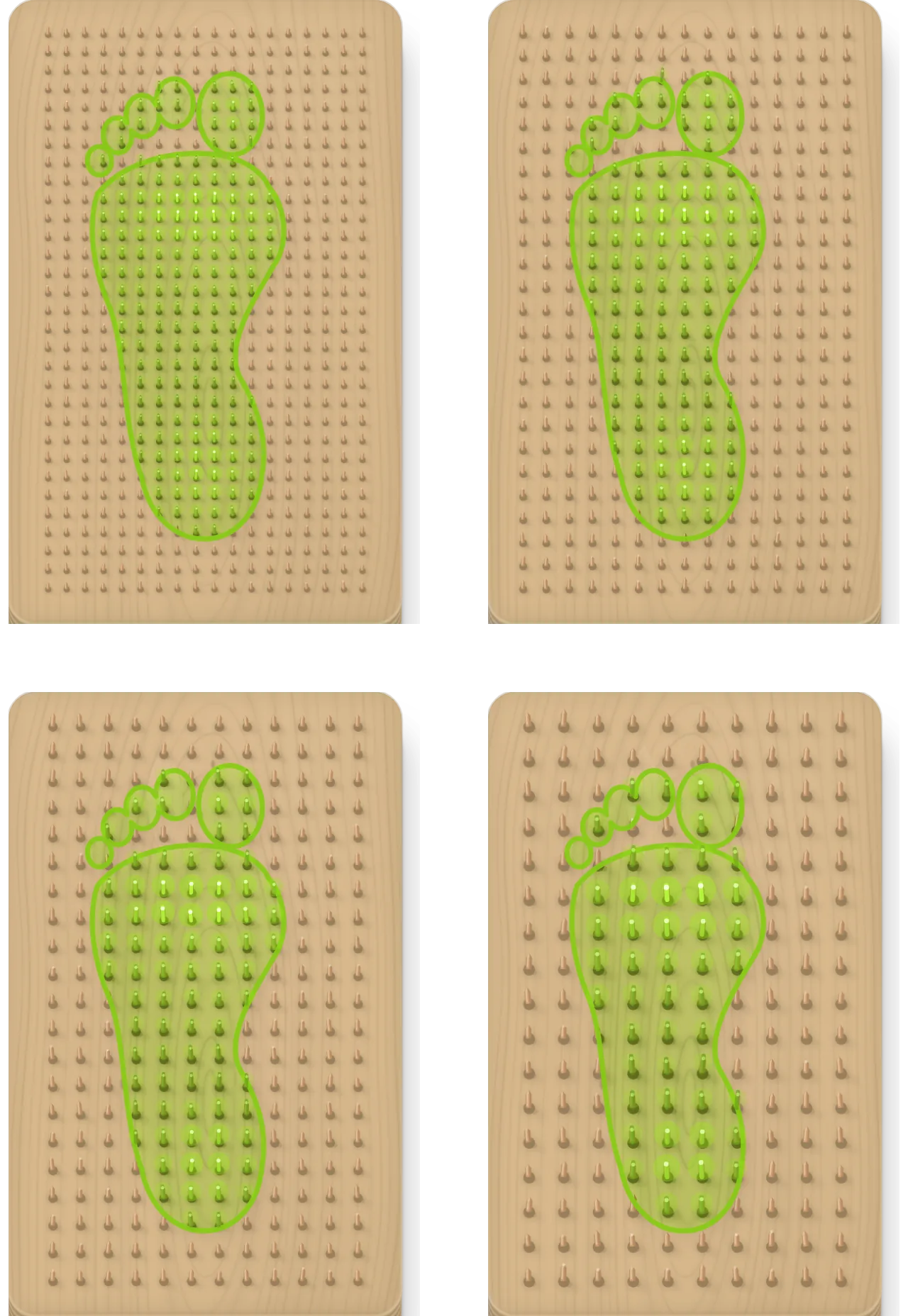
Program goals are set for 10 mm spacing and adjust to your board: a fifth shorter on 12 mm, a quarter longer on 8 mm.
Standing on nails exercises: breath, grounding, silence
Standing on nails exercises aren't poses; they're about where you put your attention. To keep daily practice from becoming “stand there and endure it”, give each week one theme, as the classic 40-day cycle does. You can try any of these without a program:
- Breath. Inhale for 4, exhale for 6. Or box breathing: in, hold, out, hold, 4 counts each. If the holds feel hard, shorten them to 2.
- Grounding. Feel the heel, the base of the big toe and the base of the little toe on each foot, and spread your weight evenly between them. Keep a soft gaze on a spot a couple of meters ahead.
- Observing. Find the sharpest point and describe it: size, shape, depth. Curiosity makes the sensation feel less like a threat.
- Sound. Draw out “Om” on the exhale, or hum quietly with your mouth closed: the vibration pulls attention away from your feet.
- Silence. No music, no looking at the timer. Notice the short pause between exhale and inhale.
None of this calls for heroics. A calm pause you count on purpose is not the same as freezing up. And if fear hits mid-practice, Sadharo's timer has a “Scared?” button: 5-5-5 breathing, a countdown from 100, and a grounding exercise where you name what you can see, touch, smell and taste.
How to make it stick
Getting used to the nails is gradual, and you can see it in three signs: your breathing stays even to the end, the sharpness fades rather than builds, and you feel better after than before. Until you see them, it's too early to add time.
To keep going past the first week:
- Same time, same place. Leave the board where you'll see it every day.
- Shorter, but daily. A couple of minutes on a hard day beats skipping. If it gets too sharp, pause the timer, step off, stand on the floor for a moment and step back on.
- A reminder. Sadharo has a daily reminder that won't fire if you've already practiced that day.
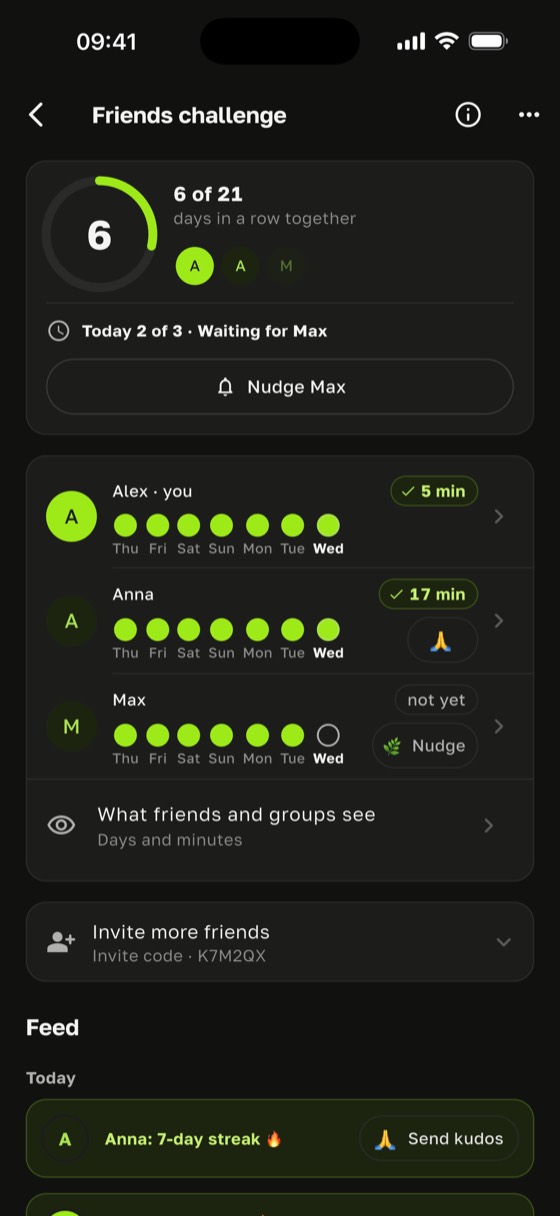
- With friends. In a challenge the streak is shared: a day counts only once everyone has been on the board, with a goal of 7, 14, 21 or 30 days in a row.

After a break the sharpness may come back; that's normal. Stand a little less than last time and build up again. Why the sensation varies from day to day is covered in does standing on nails hurt.
Side effects of standing on nails for days or weeks: when to take a break
The side effects of standing on nails for days or a week in a row are usually mild: red dots and dents on your soles that fade within a few hours. Still, practicing daily doesn't mean practicing no matter how you feel. Step off right away, slowly and holding on, and sit down if you:
- feel very dizzy or your vision darkens;
- feel sick;
- get an unusual sharp pain or numbness;
- feel weak, as if you might faint;
- suddenly feel much worse.
Don't push through dizziness or nausea: it's a signal to stop, not a “cleansing”.
Take a break if you have wounds, inflamed skin or fresh injuries on your feet, an acute illness or fever, acute pain anywhere in your body, or your period. With pregnancy, heart problems, blood pressure medication and a few other conditions, skip the practice or talk to a doctor first. The full list is in sadhu board side effects.
Questions about daily practice
Is it better to stand on nails every day or every other day?
If you have no contraindications and aren't forcing it, a little every day works better than longer sessions every other day. If daily doesn't fit your life, every other day is fine too. In Sadharo's programs a missed day never resets progress, and if you need a break you can mark a rest day without losing your streak.
What are the side effects of standing on nails for years?
There's no long-term research on standing on nails. People who have practiced for years mostly describe the sensation becoming familiar, and many move to wider spacing. The risks stay the same as on day one: falls if you get dizzy, small wounds from a poor board or jumping on, and pushing through pain. Keep checking how you feel before and after rather than chasing minutes.
What is an advanced sadhu board?
There's no special “pro” board: experienced practitioners simply stand on wider spacing. 12 mm suits people who stand calmly for 15 minutes or more, and 15 mm is for those with years of daily practice. A sharp board won't help a beginner progress faster; the sharpness just makes it harder to breathe and relax.
Will my feet get used to the nails?
Usually, yes. Many people find the first seconds stay sharp, but the calm part of the practice arrives sooner and lasts longer. If you notice wounds, numbness that doesn't pass or anything unusual, take a break and see a doctor.
Sources
- Kisker J., Schöne B. Regular use of acupressure mats reduces perceived stress at subjective but not psychophysiological levels: Insights from a three-week relaxation training. Applied Psychology: Health and Well-Being, 2023. doi:10.1111/aphw.12490
- Frizziero A. et al. Efficacy of an Acupressure Mat in Association with Therapeutic Exercise in the Management of Chronic Low Back Pain: A Prospective Randomized Controlled Study. Applied Sciences, 2021, 11(11): 5211. doi:10.3390/app11115211
This article isn't medical advice. Sadharo isn't a medical device. Effects are described from practitioners' experience and published research, not as a promise of results.