 Sadharo
History
From India's ascetics to your floor: the meaning of the sadhu board
The sadhu board origin story is shorter and more modest than many shop pages make it sound. The name points to India's sadhus, holy men and women who renounce ordinary life, and to the bed of nails, one of the austerities some of them practice. The standing board you can buy today is a much younger, much gentler thing. Here's who sadhus are, where the nails come in, why they don't pierce the skin, and what the board means now.
- The Sadharo team
- Updated September 27, 2026
- 9 min read
In short
- Sadhus are Hindu (and Jain) renunciates who give up home, family and property for a spiritual life. The word means “good” or “holy” in Sanskrit.
- Lying on nails is one form of tapas, ascetic discipline. Most sadhus never practice it, but photographs made it the best-known image of them.
- Nails don't pierce the skin because your weight spreads over hundreds of points, about 200 g (7 oz) per nail when a 70 kg (154 lb) person stands on 10 mm spacing.
- Today's board is a wellness tool, not an austerity: a few calm minutes, not a test of how much pain you can take.
What is a sadhu?
What is a sadhu in India? A sadhu is a holy person in Hinduism, and also in Jainism, who has renounced worldly life: home, family, work and property. A woman on the same path is called a sadhvi. Sadhus live apart from ordinary society or at its edges. Some wander from one pilgrimage site to the next and live on alms, others stay in ashrams, monasteries and temples, and many gather in huge numbers at the Kumbh Mela festival.
Sadhus aren't a thing of the past or a costume for tourists. They live in India and Nepal today, and their paths are very different: some focus on devotion, chanting and prayer, others on meditation, yoga or strict austerities.
What the word sadhu means
The sadhu meaning in English is “good man” or “holy man”. The Sanskrit word sādhu comes from a root meaning to reach a goal, to straighten, to master, and old texts use it for someone who is straight and right. The feminine form is sādhvī.
In Pali, the language of the early Buddhist texts, sādhu also means “good” or “well done”. That's why Buddhists in Sri Lanka, Thailand and Myanmar often say “sadhu, sadhu, sadhu” at the end of a chant or a good deed: roughly “well done, I rejoice in it”.
Why sadhus lie on nails: tapas
The origin of standing on nails lies in tapas, a Sanskrit word that literally means “heat”. In Indian traditions it stands for ascetic discipline: practices that train the body and mind to rise above comfort, cravings and fear. They range from fasting, silence and celibacy to feats of endurance, such as standing for long periods or holding one arm raised. Lying on a bed of nails belongs to that last group.
It's worth keeping this in proportion. Most sadhus never lie on nails, and for them the core of the path is renunciation, devotion or meditation. But a man on a bed of nails is striking to look at, so early photographs and travelers' accounts from India turned it into the stock image of the Indian holy man. Western writers often called such men “fakirs”, although the word, from Arabic for “poor”, originally meant a Muslim Sufi ascetic.
Why is it called a sadhu board?
Why is it called a sadhu board? Because the name borrows that famous image. There's no documented inventor or date for the standing board, and we found no evidence that sadhus used small boards like the ones sold today. The name is a nod to the tradition, not a claim of descent from it.
You'll see the same object under other names too: nail board, nail standing board, or simply standing on nails. A “bed of nails” usually means something you lie on.
Why a bed of nails doesn't pierce the skin
A bed of nails is also a classic physics demonstration: schools and science museums use it to show that the same weight spread over more points presses less on each one. One nail under a 70 kg (154 lb) person would go straight in. Hundreds of nails share the load.
On a 10 mm board, a size EU 40 foot (about US men's 7 or women's 8.5) rests on roughly 170 nails. With a 70 kg (154 lb) person standing on both feet, each nail carries about 200 g (7 oz). That's enough for a strong, sharp sensation, but not enough to pierce healthy skin on a good board. Lying down spreads the weight over far more nails still, which is why lying is usually a little gentler than standing. You can work out the numbers for your own weight in the nail load calculator.
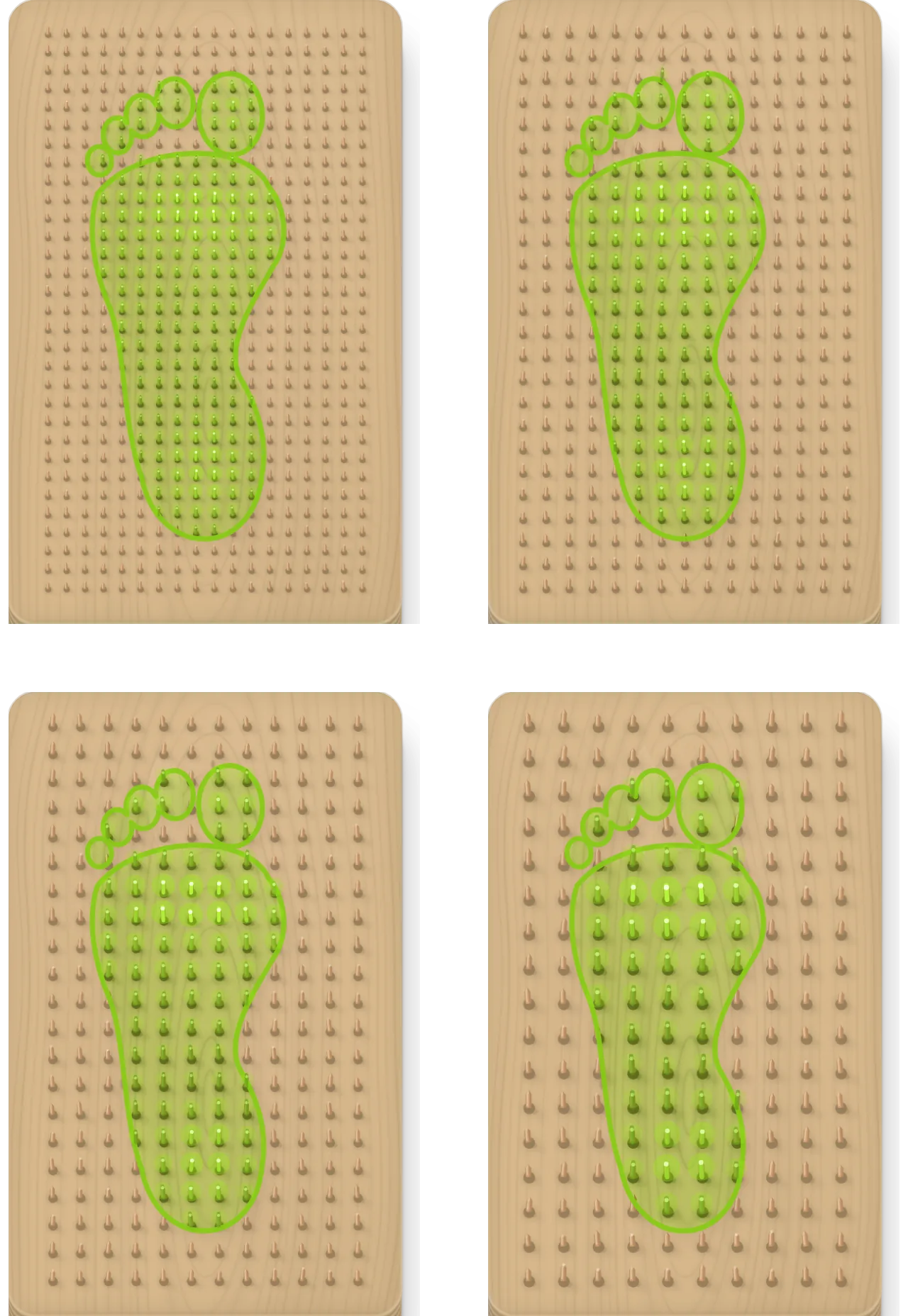
The same physics explains the stage version, where a performer lies on nails while a helper breaks a block on their chest. The dangerous moments there are getting on and off, when the weight isn't spread evenly yet. That's why every sensible guide to standing on nails says: step on slowly, never jump.
What the sadhu board means today
The sadhu board meaning has changed completely on its way into modern homes. Today's standing board is a wellness tool: two small boards with even rows of nails, usually 8 to 15 mm apart, that you stand on barefoot for a few minutes. Nobody is asked to renounce anything or prove anything, and you can buy a pair or build your own (see DIY sadhu board).
People use it to pause. The sensation under your feet pulls your attention out of your head and into your body and breath, so a few minutes on the nails work a bit like meditation for people who find sitting still hard. What practitioners report and what the research says is in sadhu board benefits.
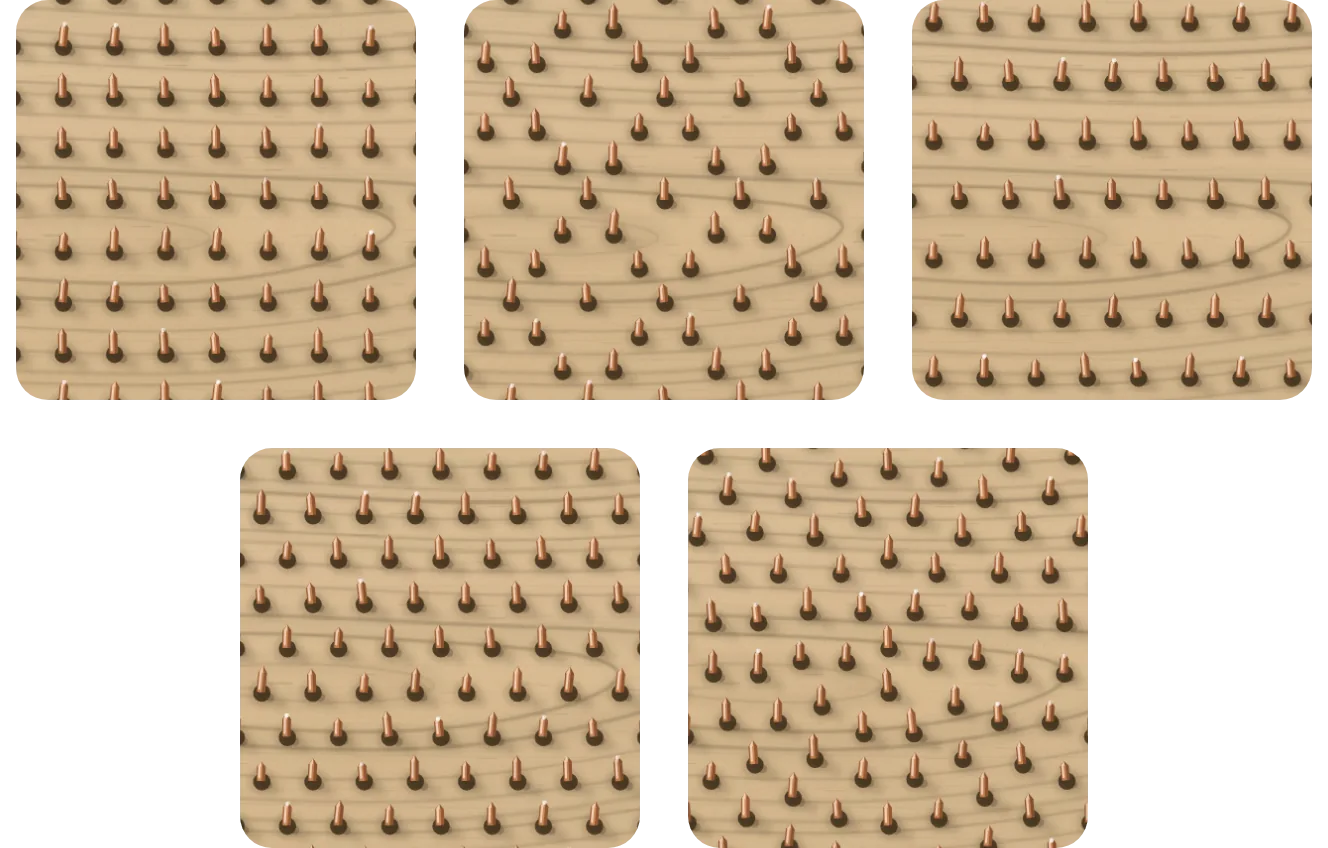
Some modern boards borrow sacred-geometry patterns such as the flower of life. They look beautiful, but the pattern is decoration: it doesn't make a board more “spiritual”, and beginners do fine on a simple grid.
A board isn't an austerity: what's different now
The biggest difference between tapas and a sadhu board at home is the goal. An ascetic's austerity is meant to be hard. A home practice works best when it's calm: short sessions, a gentle start and no heroics.
- No pushing through pain. The first seconds are sharp, but if it hurts badly, you step off. What's normal is covered in does standing on nails hurt.
- Start small. Your first practice can be one minute on a chair with your feet on the board. Step-by-step instructions are in how to use a sadhu board.
- Breathe, don't freeze. The most common mistake is to tense up until you stop breathing. Slow breathing with a long exhale is the whole technique.
- Lying is a separate practice. It needs a proper back board and extra care: see sadhu board for back.
Questions about sadhus and the nail board
What's the difference between a sadhu and a yogi?
A yogi is anyone who practices yoga as a spiritual discipline, and many yogis live ordinary family lives. A sadhu has renounced worldly life. The two often overlap: many sadhus practice yoga, but not every yogi is a sadhu.
What's the difference between a sant and a sadhu?
“Sant” means a saint, a person revered for holiness, and it's often used for India's poet-saints. It's more of an honorific than a way of life. “Sadhu” describes the life itself: renunciation and spiritual practice.
What's the difference between a sanyasi and a sadhu?
A sanyasi (sannyasi) has formally taken vows of sannyasa, renunciation, usually through initiation by a guru. “Sadhu” is the broader, everyday word for a renunciate holy person, so most sanyasis are also called sadhus.
How do you become a sadhu?
Traditionally, by finding a guru, receiving initiation into a lineage or order, and giving up home, family and property. It's a lifelong religious commitment, not something you can do through a sadhu board.
What do sadhus wear?
Many Hindu sadhus wear saffron, orange or red cloth, often with prayer beads and marks on the forehead. Some, such as the Naga sadhus, wear nothing but ash and long matted hair. Jain monks and nuns often wear white, and some Jain monks wear nothing.
Is using a sadhu board a religious practice?
No. A board at home has no religious content: it's a few minutes of standing and breathing. You can treat its name as a respectful nod to the tradition without taking on any beliefs.
Sources
- Sadhu. Wikipedia (etymology, sadhvi, dress, Kumbh Mela). en.wikipedia.org/wiki/Sadhu
- Bed of nails. Wikipedia (physics, stage and science-museum demonstrations, early photographs from India). en.wikipedia.org/wiki/Bed_of_nails
This article isn't medical advice. Sadharo isn't a medical device. Effects are described from practitioners' experience and published research, not as a promise of results.